
Handheld GPS locating devices are easy to operate and accurate to within several yards of where you stand. Your next-generation explorers will be able to return to the exact coordinates of each capsule at any time in the future. So recording GPS and photo data is important for documenting your trek.
If you don’t have one already, you’ll want a handheld GPS designed for hikers, not  highway drivers. Retail prices range from about $100 to $250. But you can probably find a lower price on eBay or Craiglist. Even a Smartphone or used GPS (like those shown) is a good alternative if the batteries last as long as your hike into the backcountry. You’ll need a waterproof device with long battery life and a built-in map screen. That display screen should be as large as you can find. You want a 12 channel parallel receiver, which gives you more incoming signals to help guide you through forest canopies or around steep hillsides. Two additional recommended options are 1) the ability to upload different topographic maps and 2) a trans-reflective color screen for viewing the GPS in full sunlight.
Any of the following GPS receivers (or your cell phone with app) are appropriate for this adventure.

eXplorist series
eTrex 20 Worldwide Handheld GPS Navigator
Garmin eTrex Vista HCx
Garmin eTrex Legend HCx Personal Navigator
Garmin eTrex Venture Cx Waterproof Hiking GPS
If you need more information on choosing and operating a handheld GPS unit, visit our References section.
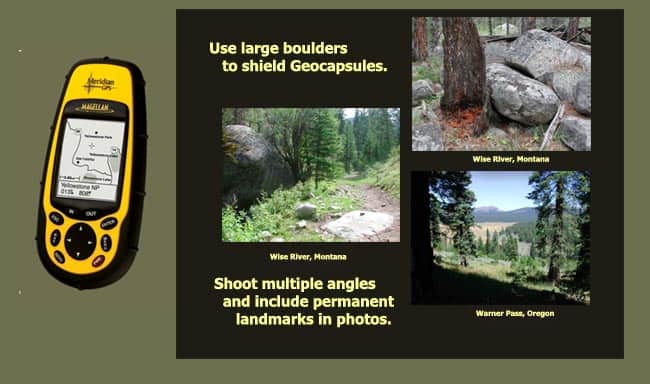
For added security, you must take photographs and create prints to slip into your Retrieval Folders. To identify permanent landmarks, shoot wide-angle images from multiple positions around your drop site. Never trust that you have taken enough documentary photos. All of the good directional photographs will be appreciated at the time of future retrieval.
Next Page: Before You Leave the Drop Site: Checklist